Save these numbers in your phone contacts before you need them. In an emergency, you do not have time to search.
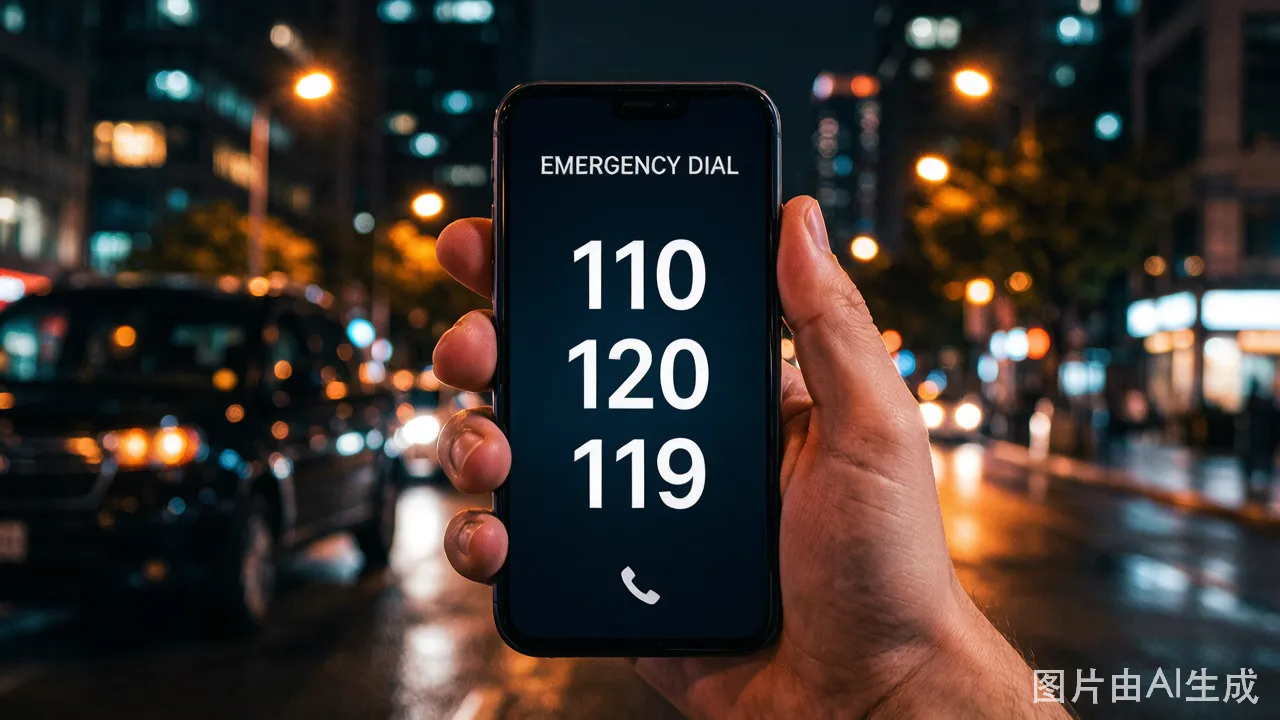
Emergency Dialing from a Chinese Phone Keypad
Your phone dialer shows the standard numeric keypad. Emergency numbers are short and easy to remember:
- 110 — Police
- 120 — Ambulance
- 119 — Fire
Dial the number and press the call button. That is it. No country code. No area code. No prefix. These numbers work on any phone in China — locked, without a SIM card, or with zero credit. Put the phone to your ear and wait for the operator.
What to Say When You Call 110, 120, or 119
Chinese emergency operators answer in Chinese. You cannot assume they speak English. This is what you say, step by step, in the exact order operators expect:
When Calling 110 (Police)
- Say "English" immediately. This alerts the operator to find a translator or transfer you.
- State the emergency type. Use short words:
- "Theft" — someone stole from you
- "Robbery" — someone threatened you and took items
- "Attack" — someone physically assaulted you
- "Missing passport" — you lost your travel documents
- "Fraud" — someone scammed you
- Give your location. The operator's first priority is dispatching officers. They need to know where. Say the street name, a landmark, or the nearest subway exit. If you do not know, say "I am at [metro station name] metro station, exit [letter]."
- Give your phone number. Say it slowly. The operator may call back if the line drops.
- Stay on the line. Do not hang up. The operator will tell you what to do next: wait for officers, go to a police station, or stay where you are.
When Calling 120 (Ambulance)
- Say "English" first.
- Describe the medical problem. Use these exact words:
- "Heart attack" — chest pain, shortness of breath
- "Stroke" — face drooping, arm weakness, speech difficulty
- "Accident" — car crash, fall from height, serious injury
- "Unconscious" — person is not awake, not responding
- "Bleeding heavily" — blood loss that will not stop
- "Difficulty breathing" — cannot catch breath
- "Allergic reaction" — swelling, hives, throat closing
- Say how many patients. "One person" or "two people."
- Give your location. As specific as possible. In a building, give the floor and room number.
- Stay on the line. The operator may give you instructions while you wait — CPR guidance, bleeding control, recovery position.
When Calling 119 (Fire)
- Say "English" first.
- Say "Fire" and describe what is burning — "apartment," "car," "kitchen."
- Say if people are trapped. "People inside" or "everyone is out."
- Give your location. Building name, street address, or visible landmark.
- Evacuate immediately after the call. Do not wait on the line. The fire department dispatches automatically.
Full English Script to Read Aloud
If you cannot say anything else, read this script into the phone:
"Hello. English. I have an emergency. I am a foreigner. I am at [INSERT LOCATION]. My phone number is [INSERT NUMBER]. Please send help. Repeat: I am at [INSERT LOCATION]. English. Please send help."
Speak slowly. Pause between sentences. The operator may put you on hold to connect a translator — do not hang up.
Screenshot Your Emergency Phrases
Before you go out each day, screenshot these phrases on your phone. When you cannot speak, show the screenshot to anyone near you or describe it to the operator.
For police:
我在 [location]. 我是外国人, 需要帮助. 请派警察. (I am at [location]. I am a foreigner. I need help. Please send police.)
For ambulance:
我是外国人. 有紧急医疗情况. 地址是 [location]. 请派救护车. (I am a foreigner. Medical emergency. The address is [location]. Please send an ambulance.)
For fire:
着火了!地址是 [location]. 请派消防车. (Fire! The address is [location]. Please send the fire department.)
Keep these screenshots in a dedicated album on your phone labeled "Emergency." Pin the album to your home screen. In a crisis, you have three swipes to reach it at most.
Backup Emergency Numbers
When 110/120/119 do not solve your problem, these numbers provide additional support:
| Number | Service | When to Call |
|---|---|---|
| 12308 | Consular Protection Hotline | Passport emergency, detention, serious accident, local authorities cannot help. Multilingual. 24/7. |
| 12110 | SMS Police Report | Cannot speak? Send a text message to 12110. Include: your location, the emergency, your name. Type in English — the system routes to a translator. |
| 122 | Traffic Accident | Road collisions only. Do not move the vehicle. Describe the location and any injuries. |
| 12345 | City Government Hotline | Non-emergency government inquiries. Can connect you to English-speaking staff in larger cities. |
| Your Embassy's Emergency Number | Embassy After-Hours Line | Save this number before you travel. Embassies handle: lost passport, detention, death of a national, serious crime victim support. |
Save all of these as contacts with the label "Emergency" in your phone's contact app. Do not rely on searching the internet in a crisis — your data connection may be down, or you may be too shaken to type.
WeChat Emergency Mini-Program
WeChat includes a built-in emergency reporting tool that bypasses phone calls entirely:
- Open WeChat.
- Tap Discover (发现) at the bottom.
- Tap Mini Programs (小程序).
- Search for "国家应急广播" (National Emergency Broadcast) or "110报警" for the official police reporting mini-program.
- The police mini-program allows text-based reporting with location auto-sharing. Type your report in English — the system translates it for dispatch.
You can also use WeChat's Pay tab to access emergency services in some cities. From the Pay screen, tap City Services (城市服务), then scroll to Police Services (公安服务). This feature varies by city but is worth setting up in advance.
Prepare Your Emergency Contact Card
Create a note on your phone with this information. Do it now. It takes two minutes.
MY EMERGENCY INFORMATION:
Name: [Your full name]
Nationality: [Your country]
Passport Number: [Your passport number]
Date of Birth: [DD/MM/YYYY]
Blood Type: [If known]
Medical Conditions: [Any/all]
Allergies: [Any medications or foods]
Emergency Contact: [Name, relationship, phone number with country code]
Travel Insurance: [Provider name, policy number, 24-hour assistance hotline]
Current Hotel: [Hotel name, address, phone number]
Lock this note or keep it in a password-protected app. If you are unconscious or cannot communicate, first responders or hospital staff can read this.
What Happens After You Call
After the operator dispatches help:
- Police (110): Officers arrive at your location. Response time in urban areas: 5-15 minutes. In rural areas: 20-40 minutes. You go to the police station to give a formal statement if the incident requires a report.
- Ambulance (120): The ambulance transports you to the nearest public hospital emergency department. You do not choose the hospital. Bring your passport and payment method. The ambulance may charge a fee (usually 100-300 RMB) collected at the hospital.
- Fire (119): Fire trucks dispatch immediately. Evacuate the building. Do not re-enter until the fire department declares it safe.