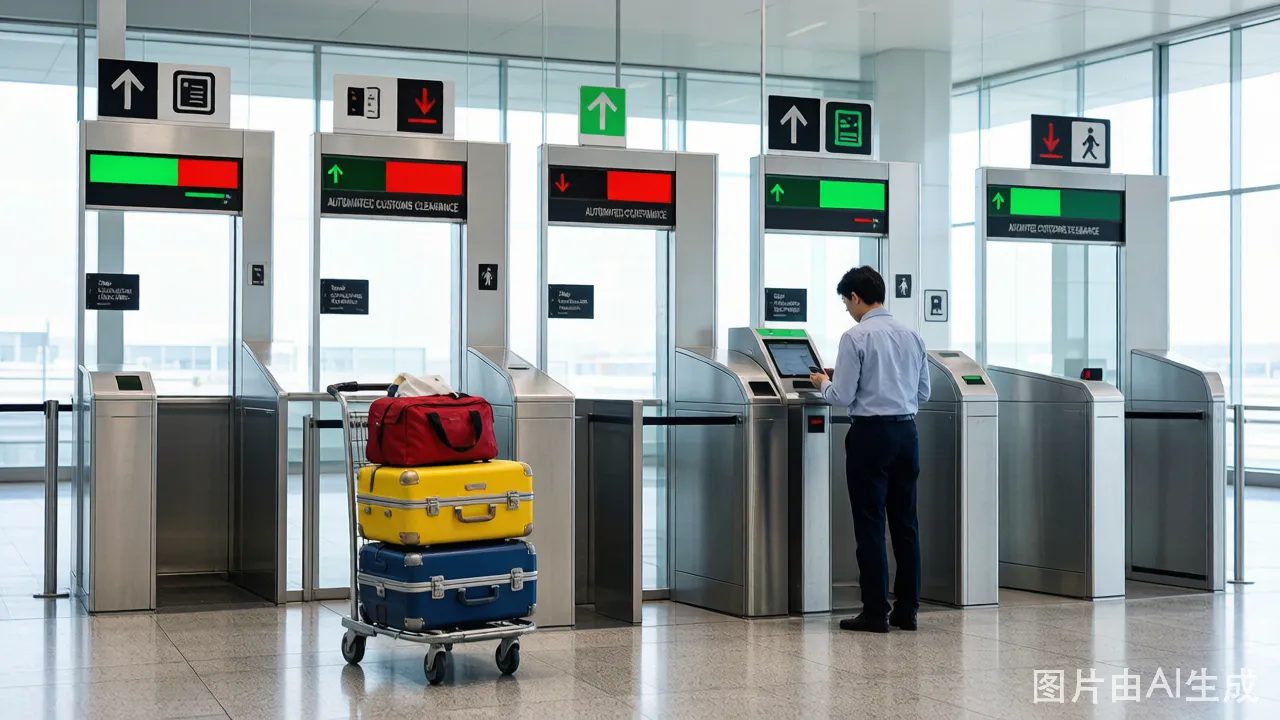
After you collect your luggage and before you exit into the arrival hall, you pass through a customs inspection zone. Two large signs hang above the lanes: one green with the English text "Nothing to Declare" and one red with "Goods to Declare." The choice is yours, and your legal responsibility. The green channel sign is not a shortcut. It is a legal statement that you carry nothing declarable.
The Two-Channel System
China Customs operates a Red and Green Channel system, consistent with international customs practice.
Green Channel — "Nothing to Declare"
Use this channel only if ALL of the following are true:
- You carry cash under 20,000 RMB or USD 5,000 equivalent in foreign currency. Example: carrying 15,000 RMB and 3,000 USD is fine. Carrying 25,000 RMB is not — that exceeds the RMB threshold even though your combined value is under USD 5,000 equivalent.
- You are not carrying goods for commercial purposes. Five identical unboxed iPhones triggers a commercial intent flag, even if you call them "gifts."
- You stay within the duty-free limits: 1,500 ml of alcohol (two standard 750 ml bottles of wine, or roughly two bottles of spirits) and 400 cigarettes (two cartons). A third bottle of wine puts you over. A single carton plus a loose pack is fine.
- You carry no prohibited or restricted items: no fresh fruit, meat, dairy, plants, soil, endangered wildlife products (ivory, certain traditional medicines), or weapons.
- You have no goods requiring a customs permit: gold exceeding 50 grams, communication equipment, or items for which China requires special import licenses.
Red Channel — "Goods to Declare"
Use this channel if ANY of the following apply:
- You carry cash above the declaration threshold (20,000 RMB or USD 5,000 equivalent). You must declare the full amount, not just the excess.
- You have goods exceeding duty-free allowances. You pay duty on the excess portion only.
- You carry items intended for commercial sale or business use — samples, inventory, equipment.
- You carry restricted items requiring a permit.
- You are unsure whether something needs to be declared. When in doubt, use Red. Declaring and being cleared costs nothing. Undeclaring and being caught costs you.
At the Red Channel, an officer takes your completed customs declaration form and may inspect the declared items. If duties apply, the officer calculates them and collects payment on the spot. Acceptable payment methods: cash (RMB), UnionPay card, and mobile payment (Alipay/WeChat Pay).
What Customs Officers Actually Ask
If stopped for inspection, officers ask short, direct questions. Expect these:
- "Do you have anything to declare?" — Answer yes or no. Do not explain, justify, or volunteer extra information.
- "What is in this bag?" — The officer points at a specific bag. Describe the contents in three to five words: "Clothes and toiletries," "Gifts for friends," "Business documents."
- "How much cash do you carry?" — State the exact amount in RMB or your currency. Approximate answers ("about 3,000 dollars") invite further questioning and a count.
- "Is this for personal use or business?" — Answer "Personal use" or "Business" directly. A bag of mixed personal items and business materials gets flagged as business.
- "Where did you buy this?" — Name the country. "Thailand," "France," "Online from the US."
- "What is the value?" — State the purchase price in the currency you paid. Have receipts accessible. No receipt means the officer estimates the value, usually at the high end of retail.
Officers use a handheld translation device or call an English-speaking colleague if language is a barrier. Speak slowly. One-word answers are perfectly acceptable.
What Happens If You Are Picked for Inspection
Customs selects travelers through three methods: X-ray image flagging, random selection, and targeted selection based on origin flight, behavior, or luggage appearance.
When selected, an officer signals you to the inspection counter. You place your bags on the X-ray conveyor belt. The officer watches the monitor and asks you to open a specific bag. They point to the item they want to examine. You take it out. They inspect it. They may swab items for explosive or drug residue traces — a 5-second process.
The officer does not empty your entire bag. They target specific items visible on X-ray. The inspection takes 2-5 minutes for a routine check, 10-15 minutes if something requires detailed examination.
Stay calm. Do not reach into your bag without being asked. Let the officer point, then you retrieve. Answer questions directly. If everything is in order, the officer waves you through. You repack your bag and proceed to the arrival hall.
What Gets Flagged on X-Ray
Items that draw customs attention:
- Dense rectangular blocks — stacks of cash, gold bars, large battery packs. Even a thick stack of documents looks suspicious. Spread cash across multiple locations.
- Organic shapes — fruit, meat, plants, animal products. A forgotten apple from the inflight meal shows up clearly on X-ray and triggers a bag inspection.
- Multiple identical electronics — three or more of the same device suggests commercial intent. Two phones and a tablet is normal. Five phones is not.
- Bottles in unusual quantities — six bottles of alcohol triggers a duty assessment. Three 750 ml bottles exceeds the 1,500 ml limit, even if the fourth bottle is half-empty.
- Metallic objects not typical for personal luggage — tools, industrial parts, large quantities of jewelry.
Exact Duty-Free Limits with Examples
| Item | Duty-Free Limit | Exceeds Limit? |
|---|---|---|
| Wine (750 ml x 2) | 1,500 ml total | No — exactly at limit |
| Spirits (1 L x 1) + Wine (750 ml x 1) | 1,500 ml total | No — 1,750 ml? Wait, that exceeds. Count carefully: 1,000 + 750 = 1,750. Yes, exceeds |
| Cigarettes (2 cartons) | 400 cigarettes | No — exactly at limit |
| Cigarettes (2 cartons + 1 pack) | 400 cigarettes | Yes — 420 cigarettes |
| Cash: 18,000 RMB + 4,000 USD | 20,000 RMB / 5,000 USD | No — under both thresholds |
| Cash: 22,000 RMB | 20,000 RMB | Yes — must declare all of it |
| 1 laptop + 1 tablet + 1 phone | Reasonable personal use | No |
| 2 identical laptops | Reasonable personal use | Borderline — may be questioned |
| 1 luxury watch (worn) | Personal effects | No — worn items are typically not assessed |
| 1 luxury watch (boxed, new) | May be dutiable | Yes — items in original packaging with tags suggest commercial intent |