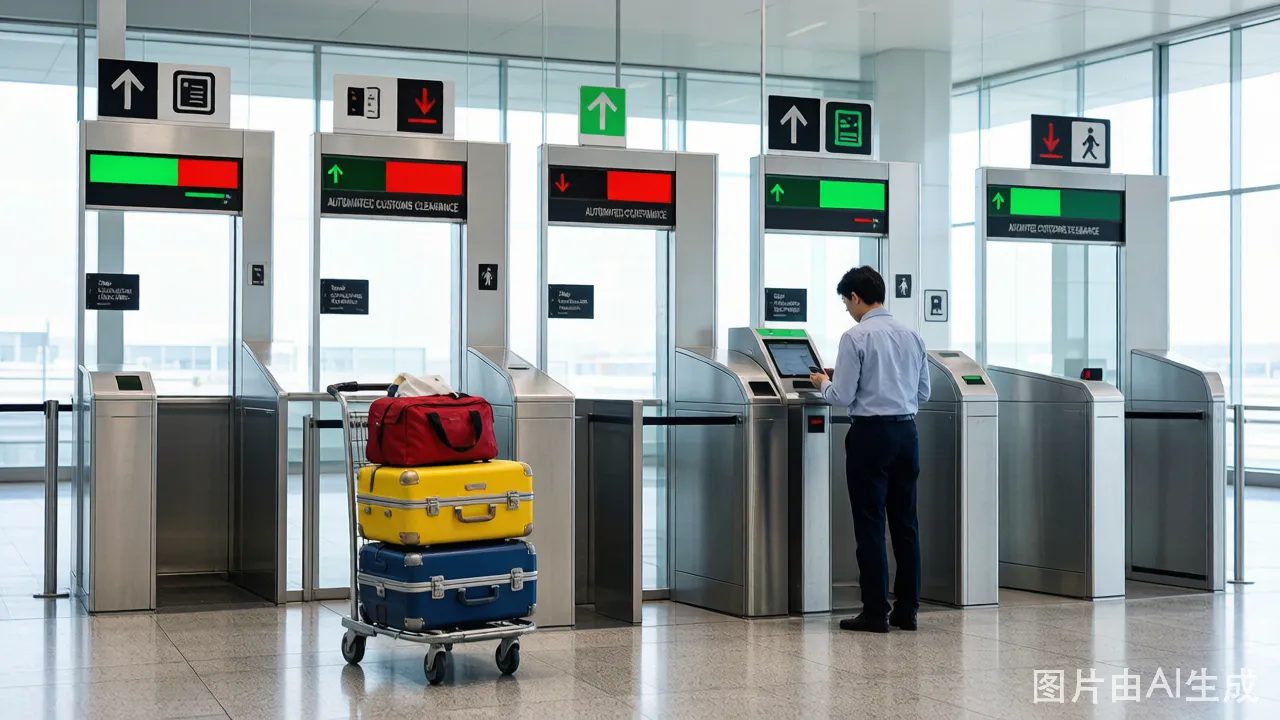
Can foreigners use the automated e-gates at Chinese airports?
Yes, but only after your fingerprints are already in the system. First-time visitors to China cannot use e-gates. You must complete at least one prior entry through a manual counter where an officer registers your fingerprints. On that first entry, the system captures all ten of your fingerprints and your facial photo. From your second visit onward, you can use the e-gates.
What are the requirements for using an e-gate?
You need all four of these:
-
Biometric passport. Your passport must have the electronic chip symbol on the cover — a rectangle with a circle inside. Non-electronic passports (issued before roughly 2010 depending on your country) will not work. The gate's passport reader cannot extract data from non-chip passports.
-
Prior fingerprint registration. Your fingerprints must exist in China's immigration database. There is no way to pre-register overseas. Your first entry through a manual counter creates the record. If you entered China before 2013 (before widespread fingerprint collection), your biometrics may not be in the system — your next entry through a manual counter will fix this.
-
Valid entry authorization. A valid visa, residence permit, or visa-free eligibility. Single-entry visa holders can use e-gates as long as the visa is unused. For multiple-entry visas, any entry within the validity window works.
-
Age 14 or older. The e-gate system does not process minors under 14. They must use a manual counter regardless of how many times they have entered.
How does the e-gate work? Step-by-step
The e-gate is a two-door channel. You enter through the first glass door into a small booth, then exit through the second. Here is exactly what happens:
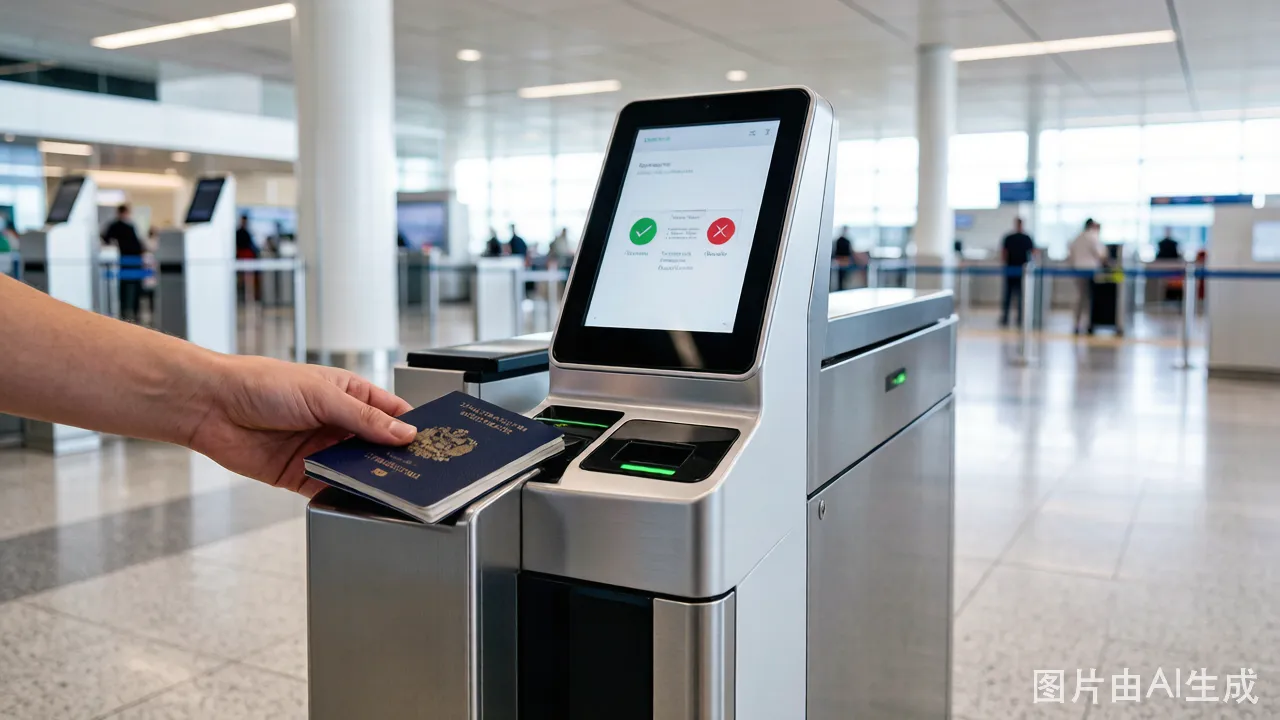
Step 1: Place your passport on the scanner. Approach the first gate. A scanner surface sits at waist height on the right side. Open your passport to the photo page. Place it face-down — the photo page must contact the scanner glass. Do not use the visa page. Do not use a passport cover. The scanner reads the chip embedded in the photo page. If the reader beeps and the first gate slides open, you placed it correctly.
Step 2: Step into the booth. Walk through the first gate. It closes behind you. You are now in a small glass enclosure, roughly the size of a phone booth. A screen in front of you at eye level displays instructions in English and Chinese.
Step 3: Place your finger on the fingerprint reader. The screen displays "Place your finger" and a hand diagram showing which finger to use. A fingerprint reader lights up — it is a small glass square below the screen, angled toward you. Place your right index finger flat on the reader. Press firmly but do not press hard — the same pressure you use on a smartphone fingerprint sensor. Hold it still for 2-3 seconds. You feel no vibration — the screen shows a checkmark or an "X." If the checkmark appears, the system matches your print.
Step 4: Look at the camera. A camera sits above the screen. The screen displays "Look at the camera." Face the camera directly. Remove sunglasses. Remove your hat if it casts a shadow on your face. Keep a neutral expression — smiling does not affect recognition but changing your facial angle does. The system takes your photo and compares it against the photo stored during your previous entry.
Step 5: Wait for the green light. If both fingerprint and facial recognition succeed, the screen displays a green checkmark and "Proceed." The second gate slides open. Walk through. You have completed entry.
Total time: 15-30 seconds from placing your passport to walking out.
Total time when things go wrong: 30 seconds before a nearby officer notices and directs you to the manual lane.
What goes wrong and how to fix it
E-gate failures are routine. They happen to 10-15% of travelers. Here is what causes them and what to do:
- Fingerprint mismatch (most common). Dry skin from airplane cabin air is the main culprit. Breathe on your finger to add moisture, wipe it on your clothing, then try again. If your right index finger fails twice, the screen prompts you to try your left index finger. If both fail, a red "X" appears and the first gate opens behind you — exit and go to a manual counter.
- Facial recognition failure. Hats, masks, and sunglasses obviously block recognition. Less obvious culprits: heavy makeup that dramatically alters your appearance, growing or shaving a full beard since your last entry, significant weight change (15+ kg), recent facial surgery. Remove all facial obstructions. Face the camera straight-on — not tilted or angled.
- System cannot read your passport chip. Older biometric passports have weaker chips. Try repositioning the passport on the scanner. If the reader still cannot extract data after three attempts, switch to a manual counter.
- No prior fingerprint record. The system has nothing to match against. The gate simply rejects you — no error message explaining why. The fix is using a manual counter this time, which registers your prints for future e-gate use.
If the gate rejects you, an officer stationed near the e-gate lanes sees the red indicator light on your booth. They approach within 10-20 seconds and direct you to a manual counter. There is no penalty, no suspicion, no additional questioning. E-gate rejection is a technical failure, not a security flag.
Which airports have e-gates for foreigners?
All major international airports. Here is the current list:
- Beijing: Capital International (PEK), Daxing International (PKX) — all terminals
- Shanghai: Pudong International (PVG) Terminal 1 and 2, Hongqiao International (SHA) Terminal 1
- Guangzhou: Baiyun International (CAN) Terminal 1 and 2
- Shenzhen: Bao'an International (SZX)
- Chengdu: Tianfu International (TFU)
- Chongqing: Jiangbei International (CKG)
- Xi'an: Xianyang International (XIY)
- Kunming: Changshui International (KMG)
- Hangzhou: Xiaoshan International (HGH)
- Xiamen: Gaoqi International (XMN)
- Qingdao: Jiaodong International (TAO)
- Dalian: Zhoushuizi International (DLC)
Smaller international airports increasingly add e-gate lanes each year. If your arrival airport is not on this list, expect a manual counter. The e-gate lane sign reads "Self-Service / E-Channel" with a passport icon.
For departure e-gates, availability mirrors the entry list above, minus some smaller airports. Beijing, Shanghai Pudong, Guangzhou, and Shenzhen have departure e-gates operational in all international terminals.
Do visa-free travelers qualify?
Yes — starting from your second visit. Your first visa-free entry requires a manual counter where the officer registers your fingerprints. Every subsequent visit during your visa-free eligibility window qualifies for e-gate use. This applies to all visa-free arrangements: 15-day, 30-day, the 24/72/144-hour transit without visa programs, and the Hainan visa-free policy.
Is there an arrival card?
No paper arrival card at most major airports. The officer at the manual counter enters your arrival information electronically. If your airline handed out paper arrival cards on the flight, fill it out in case your specific airport still uses them. Otherwise, do not search for one — you will not need it.
Can I use an e-gate on departure?
Yes. The process mirrors entry: passport scan, fingerprint verification, facial recognition, gate opens. Two differences: no entry stamp (since you are leaving, not entering), and the system checks your exit against your permitted stay period. If you overstayed, the e-gate rejects you and directs you to a manual counter where an officer handles the overstay.
Do I still get an entry stamp?
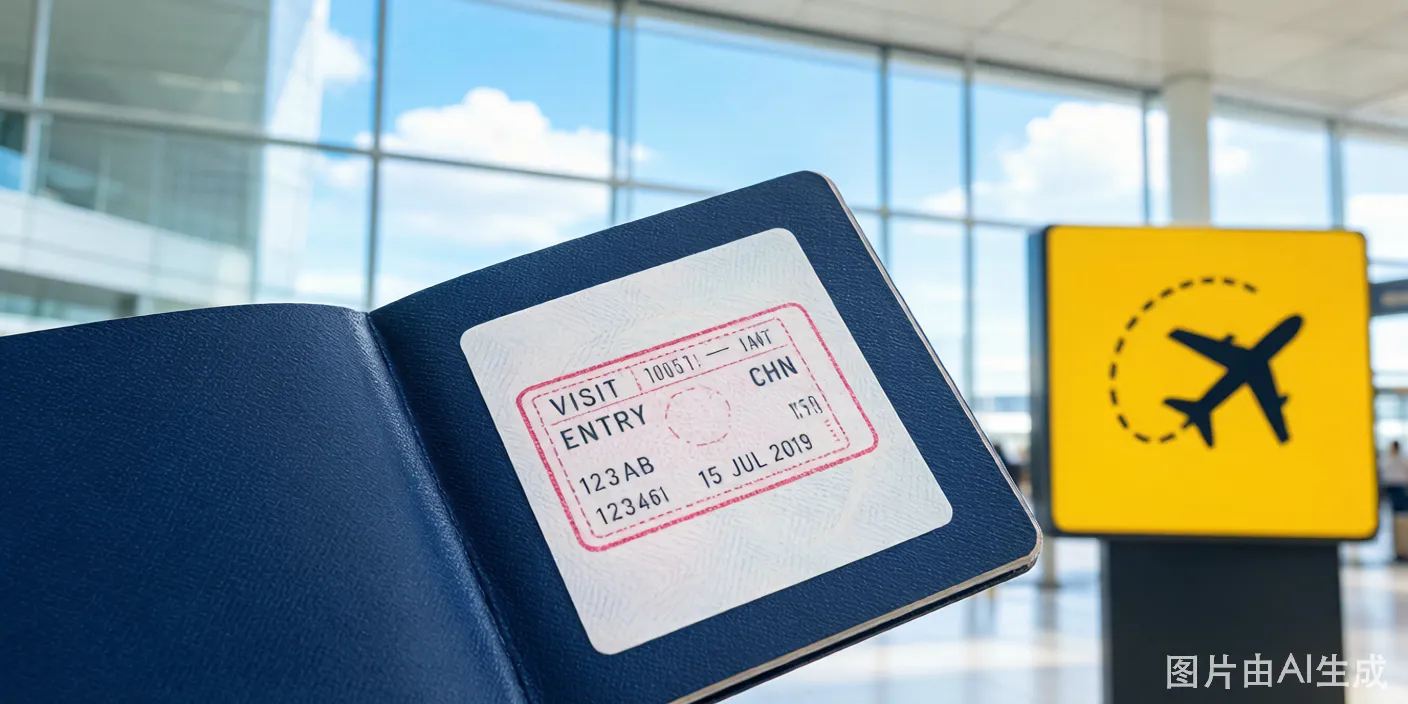
No. E-gate entry records are entirely electronic. Your passport receives no stamp. If you need proof of entry (for visa extensions, accommodation registration, bank account opening), the immigration office can print an entry record. Keep your boarding pass — it functions as supplementary proof of your travel dates.
Quick FAQ Summary
| Question | Answer |
|---|---|
| Can first-time foreign visitors use e-gates? | No — must use manual counter for fingerprint registration |
| Which passport type works? | Biometric chip passport only |
| What if the e-gate rejects me? | Officer directs you to manual counter — no penalty |
| Can visa-free travelers use e-gates? | Yes, starting from their second visit |
| Are e-gates available for departure? | Yes, same process as entry |
| Do I still get an entry stamp? | No — e-gate records are electronic |