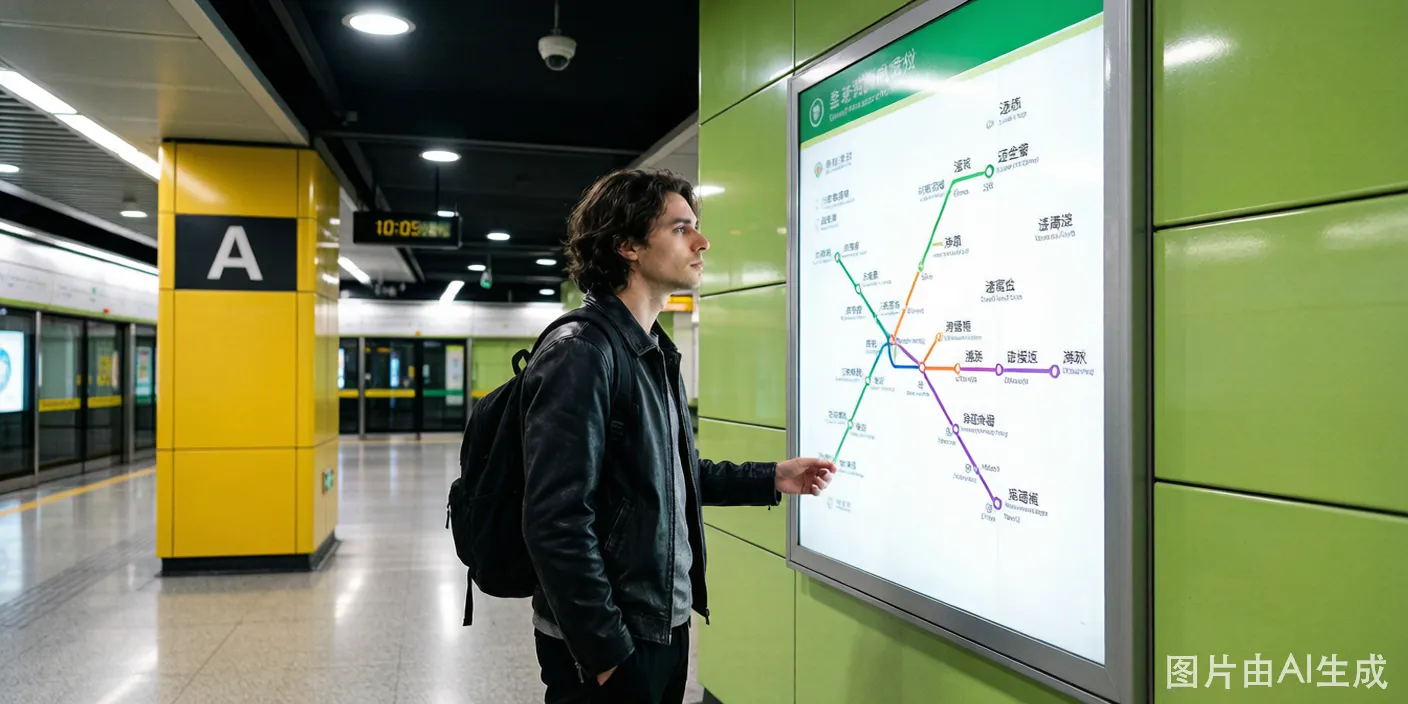
Metro systems in Chinese cities are clean, efficient, and extensive. China operates the world's largest metro network — 47 cities have operational metro systems as of 2026, with 12,000+ km of track. The payment system is the only thing that trips up foreign visitors — but with either Alipay or WeChat already on your phone, you are 90% of the way there.
Rush Hour: When to Avoid the Metro
Rush hour transforms even the most spacious Chinese metro stations into shoulder-to-shoulder crowds. Avoid these windows if you value personal space or are carrying luggage:
| City | Morning Peak | Evening Peak |
|---|---|---|
| Beijing | 7:30 AM — 9:00 AM | 5:30 PM — 7:00 PM |
| Shanghai | 7:30 AM — 9:00 AM | 5:30 PM — 7:00 PM |
| Guangzhou | 7:30 AM — 9:00 AM | 5:30 PM — 7:00 PM |
| Shenzhen | 8:00 AM — 9:30 AM | 6:00 PM — 7:30 PM |
| Chengdu | 8:00 AM — 9:00 AM | 5:30 PM — 7:00 PM |
| Chongqing | 7:30 AM — 9:00 AM | 5:30 PM — 7:00 PM |
Peak-hour reality: trains arrive every 2-3 minutes but fill immediately. You may need to let 2-3 trains pass before you can squeeze on. Lines 1, 2, and 10 in Beijing, Lines 1, 2, and 8 in Shanghai, and Line 3 in Guangzhou are the most congested. The worst individual station at peak: Xierqi (西二旗) in Beijing at 8:30 AM, where queues for platform entry extend 200 meters.
Sunday travel: Metro systems are quieter on Sundays. Saturday middays can still be busy in commercial districts. If you have flexibility, Sunday morning is the most comfortable time to ride.
Method 1: Alipay or WeChat Transit Code (Recommended)
This is the simplest method and requires no additional app download. Over 90% of metro riders in China use this method.
Alipay Transit Code: Full Setup
- Open Alipay. On the home screen, you see a grid of icons. The "Transport" icon (出行) sits in the top row or second row. It shows a small train or bus icon. If you don't see it, tap the search bar at the top and type "transport" — Alipay's English search recognizes this.
- Tap "Transport" (出行). The Transport screen opens with two tabs at the top: "Metro" (地铁) and "Bus" (公交). Select Metro.
- City detection. Alipay uses your GPS to detect your city. The city name appears at the top of the screen. If it shows the wrong city, tap the city name and search for your current city using English (e.g., type "Shanghai" or "Beijing" — both work).
- Activate the transit code. Below the city name, you see a prominent button: "Activate" or "Get Code" (开通/领卡). Tap it. A terms-of-service page appears. Scroll to the bottom (the "Agree" button is at the bottom), tap it, and the transit QR code generates within 2 seconds.
- Pay deposit (some cities). Beijing, Shanghai, and a few other cities used to require a ¥20 refundable deposit. This has been phased out in most cities as of 2025-2026. If prompted, the deposit is refunded when you deactivate the card.
- Scan to enter. At the metro station, walk up to the entry gate. Above each gate row, look for a scanner pad — a rectangular glass panel with a QR code icon. Hold your phone 5-10 cm from the scanner with the screen facing the glass. The gate beeps and opens in under half a second.
- Scan to exit. At your destination, scan the same QR code at the exit gate. The system calculates your fare (¥2-¥10 depending on distance) and deducts it from your linked Alipay payment method. A notification shows the exact fare and remaining balance.
WeChat Transit Code Setup
- Open WeChat, tap Me (bottom-right tab), then Services (服务).
- Tap Transport (交通出行) or scroll to find the "Metro" mini-program.
- If it's your first time, WeChat asks permission to access your location. Allow it.
- Select your city and activate the metro card — same activation flow as Alipay.
- The QR code appears inside WeChat. Scan at entry and exit gates.
Key differences between Alipay and WeChat:
- Alipay's Transport screen is more polished, with faster code generation and better English labeling
- WeChat's transit code sometimes needs a manual refresh — pull down on the screen if the gate doesn't respond
- Both work identically for fare calculation and deduction
- If one fails (happens to about 1 in 50 scans), switch to the other immediately rather than troubleshooting at the gate
Critical: Each city requires separate activation. Activating in Beijing does not grant you access to Shanghai's metro. The activation is free and takes under 10 seconds per city. If you visit 5 cities in one trip, activate the transit code in each city the first time you use its metro.
Method 2: City-Specific Metro Apps
Each major city has its own official metro app. These are useful if you want additional features like route planning within the app:
| City | App Name | Notes |
|---|---|---|
| Beijing | 亿通行 (Yitongxing) | Supports foreign phone registration, English available |
| Shanghai | Metro大都会 (Metro Daduhui) | English interface, foreign card payment supported |
| Guangzhou | 广州地铁 (Guangzhou Metro) | English available |
| Shenzhen | 深圳地铁 (Shenzhen Metro) | Basic English support |
| Chengdu | 成都地铁 (Chengdu Metro) | Chinese dominant, limited English |
All city apps support foreign phone number registration and foreign card payment through Alipay or WeChat Pay integration.
When to use a city app instead of Alipay/WeChat transit code: City apps provide real-time crowding data per carriage (Shanghai Metro Daduhui shows this), service disruption alerts in English, and route planning with fare estimates. Download the app for cities where you'll spend more than 3 days. For short stays, the Alipay/WeChat transit code is sufficient.
Method 3: Single-Journey Ticket (Cash Fallback)
Every metro station has self-service ticket machines that accept cash. This is your fallback if your phone is dead or your transit code is not working.
Finding the English Button
Ticket machines sit in a row near the station entrance, before the security checkpoint. They are large kiosks, typically silver or blue, with a touchscreen. The English language button is always in one of two locations:
- Top-right corner of the screen — a small flag icon (Union Jack or Stars and Stripes) or the word "English" in white text on a colored button. This is the most common placement across Beijing, Shanghai, Guangzhou, and Shenzhen.
- Bottom-left corner of the screen — less common, found in some older Chengdu and Chongqing machines.
Tap the English button before doing anything else. The entire interface switches to English immediately.
Buying the Ticket
- Select "Single Journey Ticket" on the main screen. Ignore options for stored-value cards (交通卡) — these require a Chinese ID for registration.
- Choose your destination. The screen shows one of two interfaces:
- Map view: A schematic metro map. Pinch to zoom. Tap your destination station. The fare appears automatically.
- Line + station list: Scroll through line numbers and tap your line, then tap the destination station name.
- Select quantity. The default is 1 ticket. Tap "+" if you need more. The total fare adjusts.
- Insert cash. The machine accepts: ¥1 coins, ¥5 notes, ¥10 notes, ¥20 notes. Machines in Beijing and Shanghai also accept ¥50 and ¥100 notes — look for the bill acceptor slot labeled "纸币" (paper money). Feed notes one at a time. The machine rejects torn or heavily creased notes.
- Collect your ticket and change. The ticket drops into a slot near your knees. Most cities use a round plastic token (about the size of a poker chip). Shanghai uses a contactless card. Shenzhen uses a green token. Beijing uses a dark blue token. Grab it immediately — the machine retracts uncollected tokens after 15 seconds.
- Tap at entry gate. Hold the token to the circular reader pad on the gate. The gate opens. Keep the token. You need it to exit.
- Exit. At your destination, insert the token into the slot on the exit gate (for token systems) or tap it on the reader (for card systems). The gate swallows and retains the token. If the gate fails to open, walk to the station service counter — staff will check your token and let you through.
Security Check: What to Expect
Every metro station in China has mandatory security screening. The process is fast (15-30 seconds off-peak, 1-3 minutes during rush hour) and consistent across all cities.
The setup:
- An X-ray conveyor belt for bags and large items
- A walk-through metal detector frame
- 2-4 security staff in dark uniforms with "Security Check" (安检) armbands
The process:
- Approach the security checkpoint. Remove your backpack, shoulder bag, or any bag larger than a purse.
- Place bags on the conveyor belt. The belt moves automatically — you do not need to push anything.
- Walk through the metal detector. Do not stop in the middle. Keep moving. The detector rarely beeps for watches, belts, or phones.
- Collect your bags on the other side. Bags emerge in 5-10 seconds.
What gets flagged:
- Liquids in bottles larger than 50 ml. Security may ask you to take a sip to prove it's not flammable. This happens frequently — carry your water bottle in your hand, not buried in your bag. Take a sip when asked and move on.
- Power banks and large battery packs. Security may pull your bag aside to inspect the power bank's capacity label. Power banks over 20,000 mAh are sometimes prohibited.
- Aerosol cans (deodorant, sunscreen). These attract secondary screening. Have them accessible.
- Folding knives, scissors with blades over 6 cm, and any tools resembling weapons — these get confiscated.
Pro tip: Keep your phone in your hand, not in your bag. You need it for the transit code scan 20 seconds after security. Burying it in your bag means unpacking at the gate while people queue behind you.
Reading Subway Maps
Chinese metro maps use a schematic (non-geographic) layout, identical in style to the London Underground or New York Subway maps. Understanding them takes 30 seconds of orientation.
Line identification:
- Each line has a unique color and number. Line 1 is always red in every city. Line 2 is always a shade of green or blue.
- Line numbers appear inside colored circles along the route.
- Express lines (lines that skip stations) are marked with thicker route lines and fewer station dots.
Direction:
- Direction uses terminal station names, not compass directions. A sign reading "往天安门东" means "toward Tiananmen East" — the train is heading to the terminal station called Tiananmen East. Know the name of the last station in your direction of travel.
- On platform signs, the current station is highlighted. Terminal stations appear at each end of the line diagram.
Transfers:
- Transfer stations appear as larger circles or overlapping circles where two or more line colors intersect.
- Major transfer hubs: People's Square (Shanghai, Lines 1/2/8), Xidan (Beijing, Lines 1/4), Zhujiang New Town (Guangzhou, Lines 3/5), Civic Center (Shenzhen, Lines 2/4).
Fares:
- Most cities charge ¥2-¥3 for the first 4-6 km, then ¥1 per additional 10 km. A cross-city trip in Beijing or Shanghai rarely exceeds ¥10.
- Monthly caps exist in some cities: Beijing caps at ¥100 for card users, Shanghai at ¥70.
Station Signs: What You'll See
Metro stations in China use consistent bilingual signage. Here is what you encounter from entrance to platform:
| Sign (Chinese) | English | Where You See It |
|---|---|---|
| 地铁 | Metro / Subway | Station entrance, street-level signs |
| 入口 / 出口 | Entrance / Exit | Station entry points and exit gates |
| 安检 | Security Check | Security checkpoint area |
| 售票 / 自助售票 | Tickets / Self-Service Tickets | Ticket machine area |
| 乘车 | Board / To Trains | Directional signs leading to platforms |
| 换乘 | Transfer / Interchange | Signs directing you to connecting lines |
| 开往 [station name] | To [station name] | Platform signs showing train direction |
| 卫生间 | Toilet / Restroom | Restroom location signs |
| 无障碍电梯 | Accessible Elevator | Elevator for wheelchair users and luggage |
| 客服中心 | Service Center / Customer Service | Staffed help counter inside the paid area |
Reading platform signs: Above each platform, a digital display shows:
- Line number and color (e.g., "Line 1" in a red bar)
- Terminal station in Chinese and English
- Arrival countdown: "2 min" / "5 min" — trains run every 2-8 minutes depending on the line and time of day
- On newer systems (Shanghai, Shenzhen, Beijing Lines 6/7/14/16/17): carriage-by-carriage crowding levels shown as colored bars — green (empty), yellow (moderate), red (full)
Navigating Transfers at Major Stations
People's Square (Shanghai) — Lines 1, 2, 8
People's Square is Shanghai's busiest transfer station, handling 1.2 million passengers daily. Three lines intersect here across 3 underground levels.
- Line 1 platform: B2 level. Red line, north-south orientation.
- Line 2 platform: B3 level. Green line, east-west orientation.
- Line 8 platform: B1 level. Blue line, north-south orientation.
Transfer routes:
- Line 1 to Line 2: From the Line 1 platform, follow signs marked "Line 2 / 换乘2号线" (green). Walk up one level via escalator. The passage takes 4-6 minutes — it's one of Shanghai's longest underground walks. Do not try to transfer between Lines 1 and 2 at People's Square during peak hour unless you have no alternative. The corridors become single-file human rivers.
- Line 1 to Line 8: Signs marked "Line 8." Transfer is shorter — 2-3 minutes via a direct corridor.
- Line 2 to Line 8: Even shorter — one level apart, 2 minutes.
Exit strategy at People's Square: The station has 20 exits numbered 1-20. Each leads to a different corner of People's Square and surrounding streets. Before you exit, check the yellow exit guide map next to the gates. Exit 1 leads to Nanjing Road East, Exit 9-10 to Shanghai Museum. Choosing the wrong exit adds 10-15 minutes of above-ground walking through one of Shanghai's largest intersections.
Xidan (Beijing) — Lines 1, 4
Xidan is Beijing's central commercial interchange. Lines 1 (east-west) and 4 (north-south) cross here.
- Line 1 platform: Deep level (B2). Older line, narrower platforms.
- Line 4 platform: Higher level (B1). Newer, wider platforms and brighter lighting.
Transfer: From Line 1, walk to the center of the platform and take the escalator up one level. Follow overhead signs marked "Line 4 / 换乘4号线." The passage is short — 2 minutes. From Line 4 to Line 1, reverse direction. The Line 1 platform is a level below.
Xidan exit warning: Exits F1 and F2 lead to the Xidan shopping district. Exit E leads to Xidan North Street. Exits are clearly marked with both number and nearby landmarks. The station has 8 exits total.
General Transfer Rules
- Follow the colored line indicators. Transfer corridors use colored strips on the floor matching the destination line color. If you transfer to Line 2 (green), follow the green strip.
- Transfer time buffers. At People's Square, Xizhimen (Beijing), Nanjing Road East, and similarly large stations, budget 5-8 minutes just for the transfer walk. Smaller stations take 1-3 minutes.
- Last train at transfer stations. The last connecting train at a transfer station is not necessarily the same time as the last train from the originating line. Posted signs at transfer corridors show the last train time for each connecting line. If you transfer after 10:30 PM, check these times.
- Do not exit the paid area. Transfers happen inside the fare gates. You do not scan your code or insert your token between lines. If you accidentally exit through a fare gate, you pay for a new journey to re-enter.
What to Do If You Lose Your Ticket
Lost Single-Journey Token
If you drop your token on the train or platform and cannot find it:
- Go to the Service Center (客服中心) near the exit gates. This is a staffed booth, usually glass-walled, with a sign in Chinese and English.
- Explain the situation. Staff at major city stations speak basic English. Say "I lost my ticket" or show a translation on your phone: "我丢了车票" (wǒ diū le chē piào).
- Pay the maximum fare. You pay the highest possible fare for that metro line — typically ¥9-¥14 in Beijing and Shanghai. Staff issue a replacement exit ticket.
- Keep the receipt. If you find your original token later, you can sometimes get a refund at the same station service center. This works about 50% of the time.
Phone Dead / Transit Code Not Working
If your phone battery dies mid-journey:
- Go to the Service Center at your destination station.
- Tell staff your starting station. They can look up the fare on their system.
- Pay cash for the fare amount. Service centers always accept cash.
- Staff will let you through the exit gate manually.
Lost Transit Card (Stored-Value Card)
If you bought a physical stored-value card (not recommended for short visits):
- Report the loss immediately at any Service Center.
- Provide your passport number. Staff can look up and freeze the card.
- The remaining balance transfers to a new card, minus a ¥20 replacement fee.
- This is not possible for anonymous cards purchased without ID registration.
Accessibility
Chinese metro systems have improved accessibility significantly since 2018. Here is the current state as of 2026:
Elevators:
- Every station built after 2015 has at least one street-to-platform elevator. Stations built before 2015 are being retrofitted — about 85% of Beijing stations and 90% of Shanghai stations now have elevator access.
- Look for the wheelchair symbol and "无障碍电梯" (Accessible Elevator) sign. These are typically near Exit A or the exit closest to the street corner.
- At street level, elevator entrances are marked with a blue sign showing a wheelchair icon. They are sometimes set back 10-20 meters from the main stairway entrance.
Platform accessibility:
- Gap between platform and train: 5-15 cm depending on the station age. Newer stations (Line 14+ in Beijing, Line 12+ in Shanghai) have near-flush boarding.
- Tactile paving (yellow bumpy tiles) leads from elevator to platform edge in all stations.
- Priority seating is marked in a different color (usually orange or yellow) at the end of each carriage.
Service for passengers with disabilities:
- Beijing Metro: Call 010-96165, 24 hours in advance, to request staff assistance at any station. Staff will meet you at the entrance and escort you to the platform.
- Shanghai Metro: Call 021-64370000 for accessibility assistance. Same-day requests are possible at major stations.
- Shenzhen Metro: On-demand assistance at service centers. No advance booking required.
Restrooms:
- Restrooms exist in about 70% of metro stations. They are always outside the fare gates (before entry or after exit). Stations without restrooms are typically older ones on Lines 1 and 2 in Beijing and Shanghai.
- Restroom signs: "卫生间" or "洗手间." Free. Bring your own toilet paper and hand soap — both are frequently empty.
- Accessible restrooms are available at all stations that have restrooms.