China offers multiple transit visa-free policies for travelers passing through on their way to a third destination. The policy you can use depends on how long you are staying and which city you are entering through.
The Three Transit Visa-Free Options — Comparison Table
| Feature | 24-Hour Transit | 144-Hour Transit | 240-Hour Transit |
|---|---|---|---|
| Duration | 24 hours from scheduled arrival | 144 hours (6 calendar days) | 240 hours (10 calendar days) |
| Eligible Nationalities | All nationalities (with valid onward ticket) | 54 countries only | 54 countries only |
| Where Available | All open ports nationwide | 20+ designated regions | Select cities only (Chongqing, Xi'an, Xiamen) |
| Movement Within Region | Usually restricted to port area; temporary entry permit needed to leave | Free movement within the designated administrative region | Restricted to the entry city's administrative boundaries |
| Can Visit Multiple Cities | No — limited to port city and immediate area | Yes — within the designated region (e.g., Shanghai-Suzhou-Hangzhou) | No — single city only |
| Exit Port Flexibility | Must exit through a port in the same region (or the same port) | Can exit from any designated port within the same region | Must exit from a port in the entry city |
| Useful For | Short layover, same-day connection | Multi-day stopover, business trip, tourism | Extended layover, short business trip |
| Clock Starts | Scheduled arrival time | Midnight after arrival (arrive at 11 PM → clock starts at midnight = effectively 6 full days) | Midnight after arrival |
Route Diagram — How Transit Works
A valid transit route looks like this:
Country A (Origin) → China (Transit City) → Country B (Destination, must be different from Country A)
Examples of valid routes:
- London → Beijing → Tokyo — UK to China to Japan. Third country is different. Valid.
- New York → Shanghai → Hong Kong — US to China to Hong Kong SAR. Hong Kong counts as a third region. Valid.
- Sydney → Guangzhou → Bangkok — Australia to China to Thailand. Valid.
- Paris → Chengdu → Singapore — France to China to Singapore. Valid.
Examples of invalid routes:
- London → Beijing → London — Returns to origin country. Not transit. Invalid.
- Seoul → Shanghai → Seoul — Round trip. Invalid.
- Los Angeles → Shanghai → New York — Both departure and arrival in the same country (USA). Invalid.
- Tokyo → Beijing → Osaka — Both in Japan. Invalid.
The rule is simple: your destination must be a different country or region from where you started. Hong Kong, Macau, and Taiwan count as separate third regions, so London → Shanghai → Hong Kong is valid even though Hong Kong is part of China (it has a separate immigration system).
24-Hour Transit (All Ports Nationwide)
The most flexible option. Available at all open ports throughout China. If you hold a valid international travel document and a confirmed onward ticket departing within 24 hours, you can:
- Stay in the port's restricted area without any additional permit
- Apply for a temporary entry permit at the border inspection if you need to leave the restricted area (for a hotel, for example)
This covers virtually everyone, regardless of nationality, as long as you have a transit ticket. The 24-hour clock starts at the scheduled arrival time.
144-Hour Transit — Eligible City Map
This is the most practically useful option for tourists and business travelers. Citizens of 54 countries can stay up to 144 hours (6 days) in the following designated regions:
Eastern China (Shanghai-Jiangsu-Zhejiang Region):
- Entry/exit ports: Shanghai Pudong (PVG), Shanghai Hongqiao (SHA), Nanjing Lukou (NKG), Hangzhou Xiaoshan (HGH)
- You can move freely between Shanghai, Suzhou, Hangzhou, Nanjing, Ningbo, and other cities within Jiangsu and Zhejiang provinces.
- Example: fly into Shanghai PVG, take the high-speed train to Hangzhou, then Suzhou, then depart from Nanjing NKG. All within one region.
Northern China (Beijing-Tianjin-Hebei Region):
- Entry/exit ports: Beijing Capital (PEK), Beijing Daxing (PKX), Tianjin Binhai (TSN), Shijiazhuang Zhengding (SJW)
- Movement allowed between Beijing, Tianjin, and Hebei province cities.
- You cannot go to Shanxi, Inner Mongolia, or other neighboring provinces.
Southern China (Guangdong Region):
- Entry/exit ports: Guangzhou Baiyun (CAN), Shenzhen Bao'an (SZX), Jieyang Chaoshan (SWA)
- Movement allowed throughout Guangdong province. This means you can enter through Guangzhou, visit Shenzhen, and depart from either city.
Other participating regions:
- Liaoning (Shenyang, Dalian) — 2-city cluster
- Sichuan (Chengdu) — city-region
- Shaanxi (Xi'an) — city-region
- Xiamen (Fujian) — city-region
- Qingdao (Shandong) — city-region
- Wuhan (Hubei) — city-region
- Kunming (Yunnan) — city-region
The crucial rule: you must stay within the administrative boundaries of the announced region. Cross into an adjacent province and you have left your legal transit zone. High-speed trains and highways cross these boundaries without obvious physical checkpoints, but hotel registration systems, random police checks, and the exit port inspector can all detect where you have been.
240-Hour Transit (Select Cities)
A newer option allowing 10 days. Currently available at Chongqing, Xi'an, and Xiamen ports. The same 54-country list applies. You must stay within the administrative boundaries of the entry city. This is useful if you need an extended layover or a short business trip to a single city.
Who Qualifies
The 54 eligible countries include: all EU member states, the United Kingdom, United States, Canada, Australia, New Zealand, Japan, South Korea, Singapore, Malaysia, Thailand, Russia, Brazil, Argentina, Chile, Mexico, and others. The full list is published by the National Immigration Administration.
Airline Check-In Verification
Your airline plays a role in the transit process even before you reach China. Here is what happens:
At your departure airport, the check-in agent verifies that you have the right to enter China. When you present a passport without a Chinese visa, the agent will check:
- That your nationality is on the eligible list (for 144/240-hour transit) or that you have a valid onward ticket within 24 hours (for 24-hour transit)
- That your onward ticket is confirmed (not waitlisted) and is to a third country
- That your entry and exit ports match the transit policy you intend to use
The agent pulls up the TIMATIC database (the same system all airlines use for visa and entry requirement checks) and verifies your eligibility. If TIMATIC flags an issue — for example, your onward destination is the same as your departure country — the system shows a warning and the agent may deny boarding.
Print your onward flight confirmation. A phone screenshot works at Chinese immigration, but at the departure airport check-in counter, the agent often wants to see a printed itinerary or at least a PDF on your phone showing the booking reference, flight number, date, and destination. Having this ready avoids delays.
If the check-in agent denies you boarding and you believe you qualify for transit, ask them to verify the specific transit policy for your nationality and ports. Policies change and not all agents are current. Politely request a supervisor review if needed. Chinese immigration makes the final decision on entry — the airline's check-in verification is a pre-screening to avoid you being turned back at the border, which the airline would be responsible for.
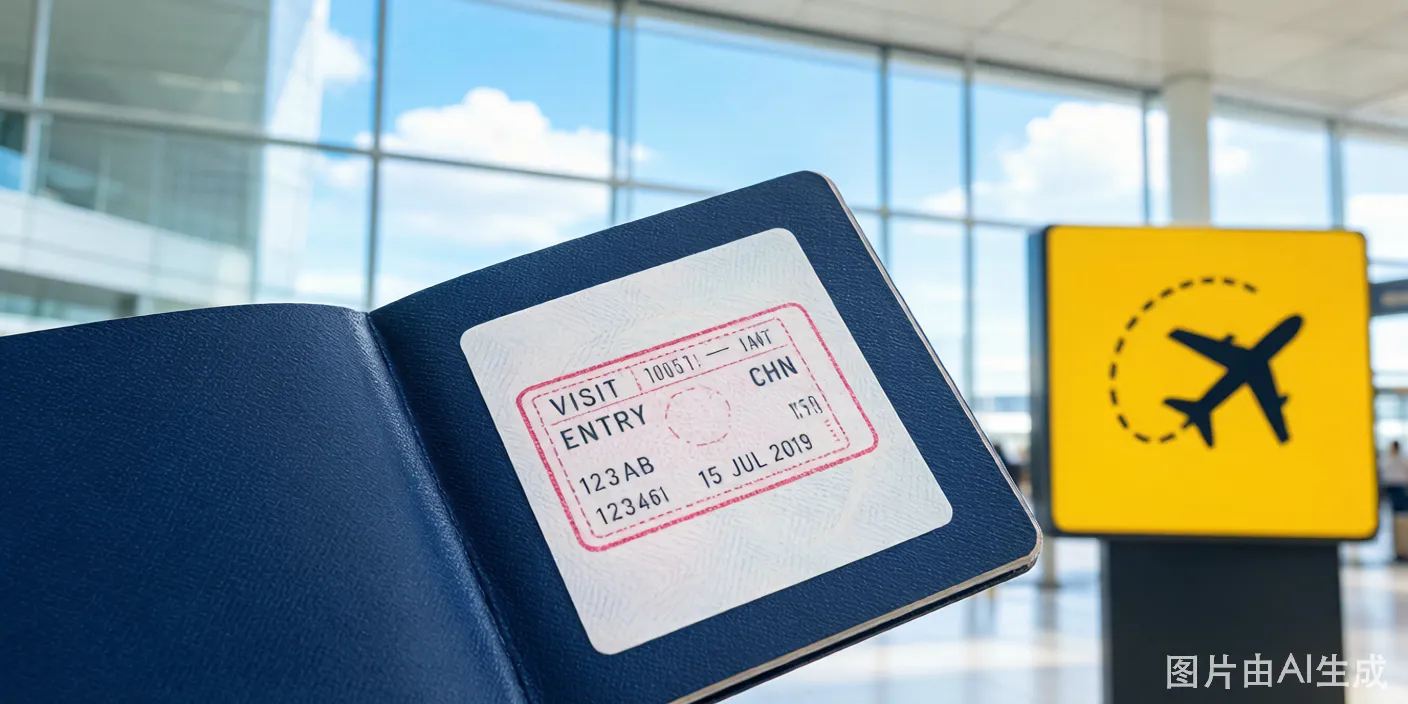
What the Transit Stamp Looks Like
At Chinese immigration, when you enter under a transit visa-free policy, the officer places a rectangular entry stamp in your passport. Unlike a regular visa entry stamp, the transit stamp has additional text in Chinese that identifies you as a transit passenger.
The stamp includes:
- The date of entry
- The port of entry
- The type: "临时入境许可" (Temporary Entry Permit) or a similar designation
- A handwritten or printed notation of the permitted stay duration (24H, 144H, or 240H)
- The date by which you must depart
The transit stamp does not look like a visa sticker. It is a standard immigration stamp with the transit designation. Do not be alarmed if the stamp looks different from stamps you have received at other Chinese border crossings.
What You Can Actually Do During Transit
24-Hour Transit
You have one day. Practically, here is what works:
- Leave the airport, take the metro to the city center, grab a meal, see one or two landmarks, return to the airport
- Book an airport hotel and sleep (no sightseeing at all)
- Do a short business meeting if your meeting location is within a reasonable distance of the airport
You cannot realistically: visit multiple cities, do a full tourist itinerary, or stay overnight outside the port city.
144-Hour Transit (6 Days)
This is a proper mini-vacation. You can:
- Check into a hotel anywhere in the designated region
- Travel between cities using high-speed rail, regular train, or domestic flight (all within the region)
- Eat at restaurants, visit attractions, go shopping, attend meetings — essentially anything a tourist or business traveler without a visa would do
- Use ride-hailing apps, order food delivery, book train tickets through apps set up with your foreign card
You cannot:
- Fly to Hong Kong as your onward connection from a city not in the designated region
- Visit your friend in a neighboring province
- Extend your stay beyond 144 hours for any reason except a genuine medical emergency or force majeure (airline cancellation, natural disaster)
240-Hour Transit (10 Days)
Similar to 144-hour, but restricted to a single city. You can explore the city in depth, take day trips to nearby towns within the same administrative area, and conduct business meetings. The extra four days make it possible to settle into a rhythm rather than rushing through attractions.
Key Rules That Cause Problems
- The onward ticket must go to a third country/region. Flying from London to Beijing to Tokyo qualifies. Flying from London to Beijing to London does not. Hong Kong, Macau, and Taiwan count as third regions.
- You must stay within the administrative region. Each transit policy is tied to specific geographic boundaries. Leave the region and you have left your legal transit zone.
- The clock starts at midnight after arrival (same as visa-free stays). If you arrive at 11 PM, your first "day" does not begin counting until the next midnight.
- You cannot extend a transit stay. If you miss your onward flight, you must leave the transit region and go directly to a port to depart — or deal with overstay consequences.